How Big Is One Million? A Simple Way to Actually Imagine 1,000,000
How big is one million?
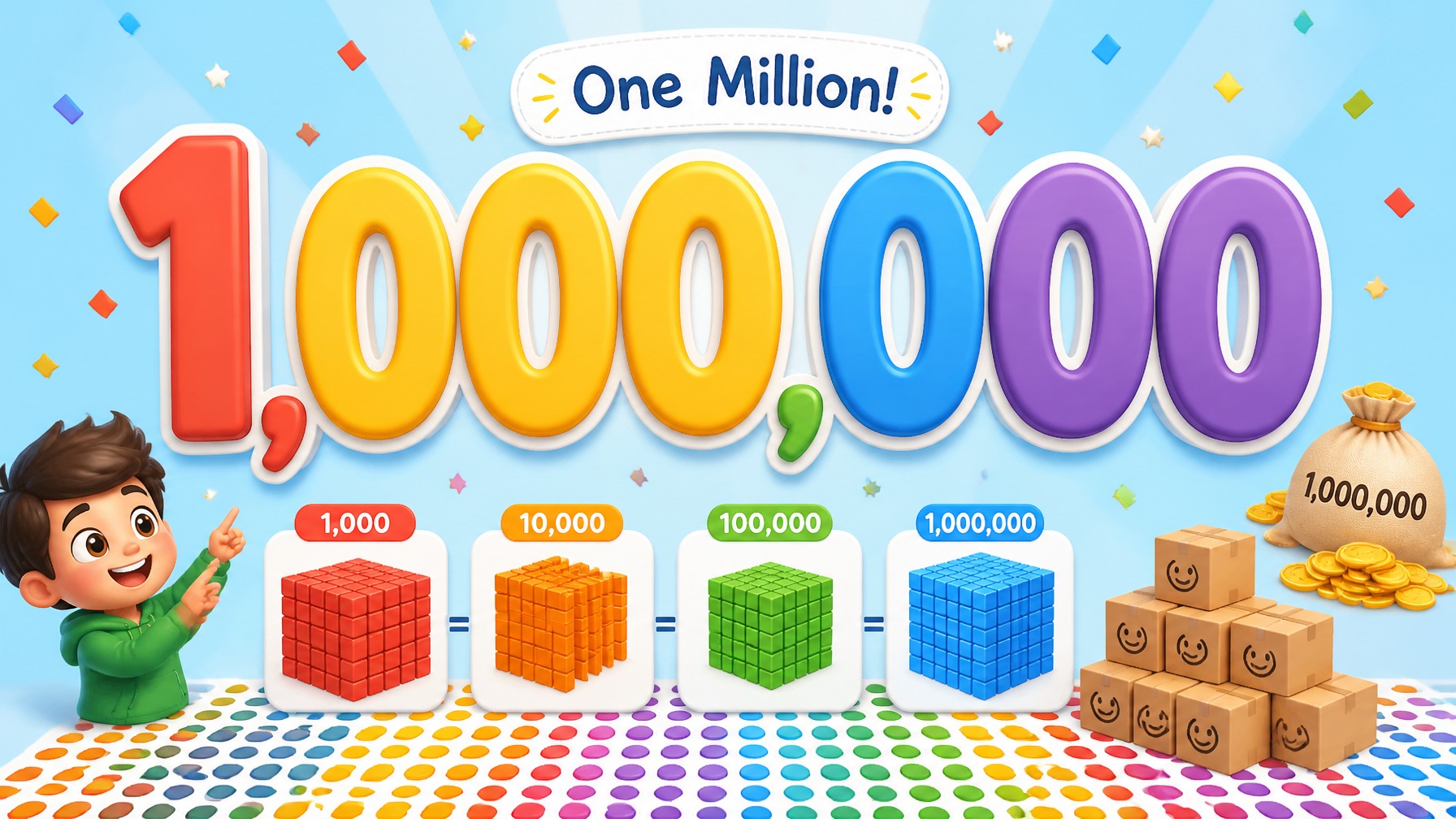
One million is written as 1,000,000. It is a 1 followed by six zeros.
But here is the more useful answer:
One million is too big to understand by counting one by one. To understand one million, you need to think in groups.
That is the big idea.
When numbers are small, you can count them.
You can count 10 fingers.
You can count 20 pencils.
You can count 100 blocks if you are patient.
But one million is different.
One million is the kind of number where your brain needs a new trick. Instead of counting one item at a time, you start grouping smaller numbers together.
That is how big numbers become easier.
The easiest way to understand one million
The easiest way to understand one million is this:
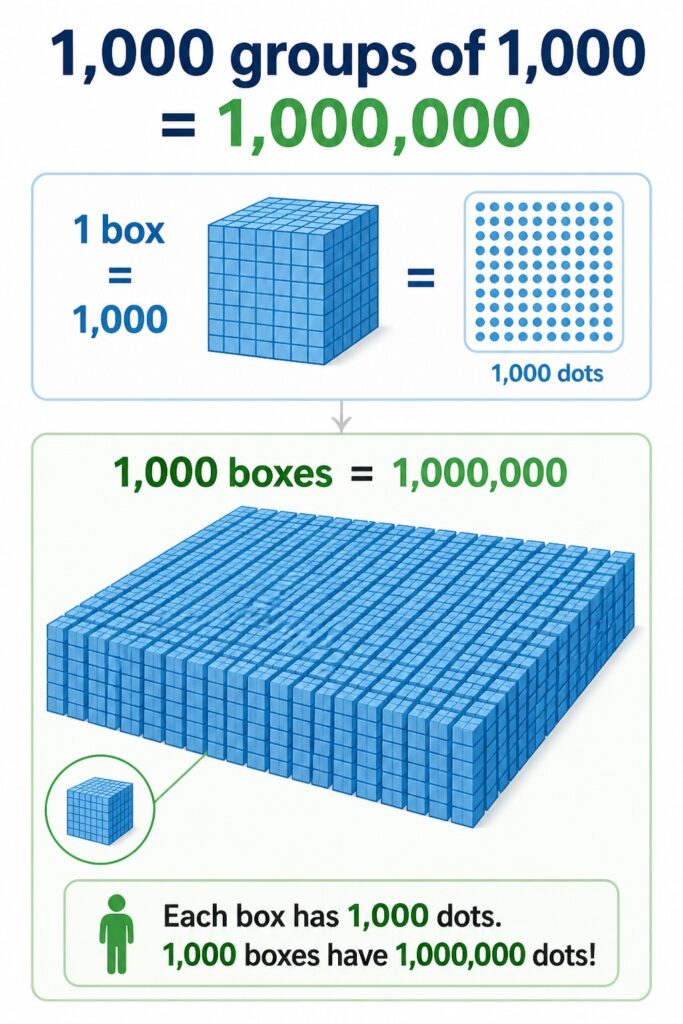
One million is 1,000 groups of 1,000.
Imagine you have one box.
Inside that box, there are 1,000 tiny beads.
Now imagine you have 1,000 boxes like that.
That gives you:
1,000 × 1,000 = 1,000,000
So one million is not just “a lot.”
It is a thousand thousands.
That is the simplest way to feel the size of one million.
How many zeros are in one million?
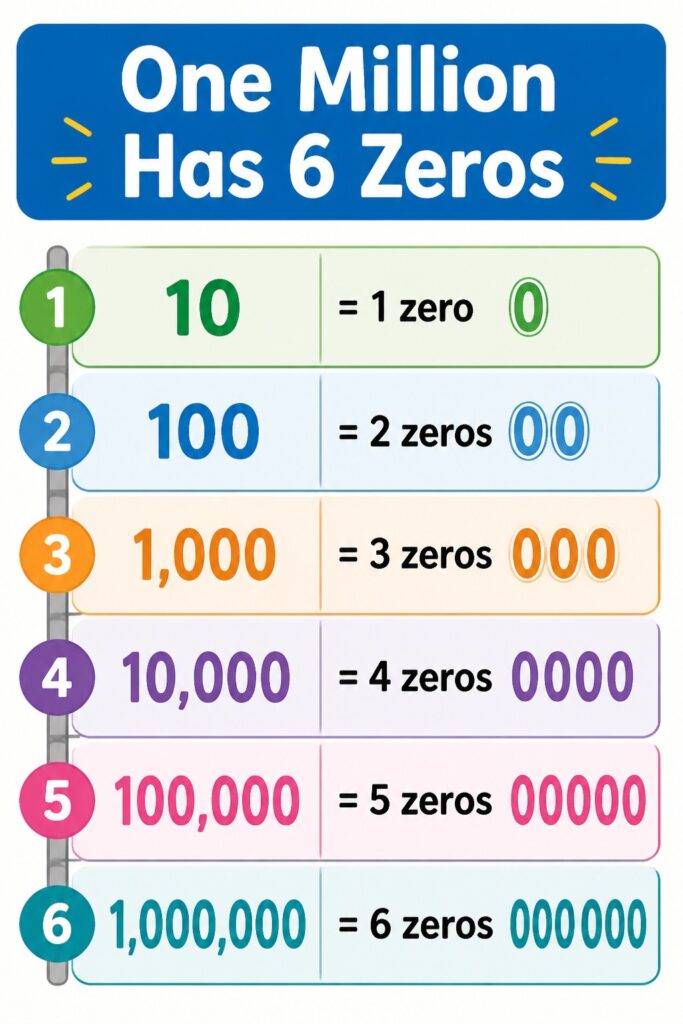
One million has six zeros.
It looks like this:
1,000,000
Here is a simple place value ladder:
| Number | Written Form | Number of Zeros |
| Ten | 10 | 1 |
| Hundred | 100 | 2 |
| Thousand | 1,000 | 3 |
| Ten thousand | 10,000 | 4 |
| Hundred thousand | 100,000 | 5 |
| One million | 1,000,000 | 6 |
A simple memory trick:
Million = 6 zeros
Why one million feels so hard to imagine
One million feels difficult because we do not normally see one million things in front of us.
You might see:
- 10 fingers
- 30 students in a classroom
- 100 toys on a shelf
- 1,000 pieces in a puzzle
But one million?
That is much harder to picture.
The problem is not that one million is impossible to understand. The problem is that our everyday life does not usually show us one million objects at once.
So we need comparisons.
One million dots: what would it look like?
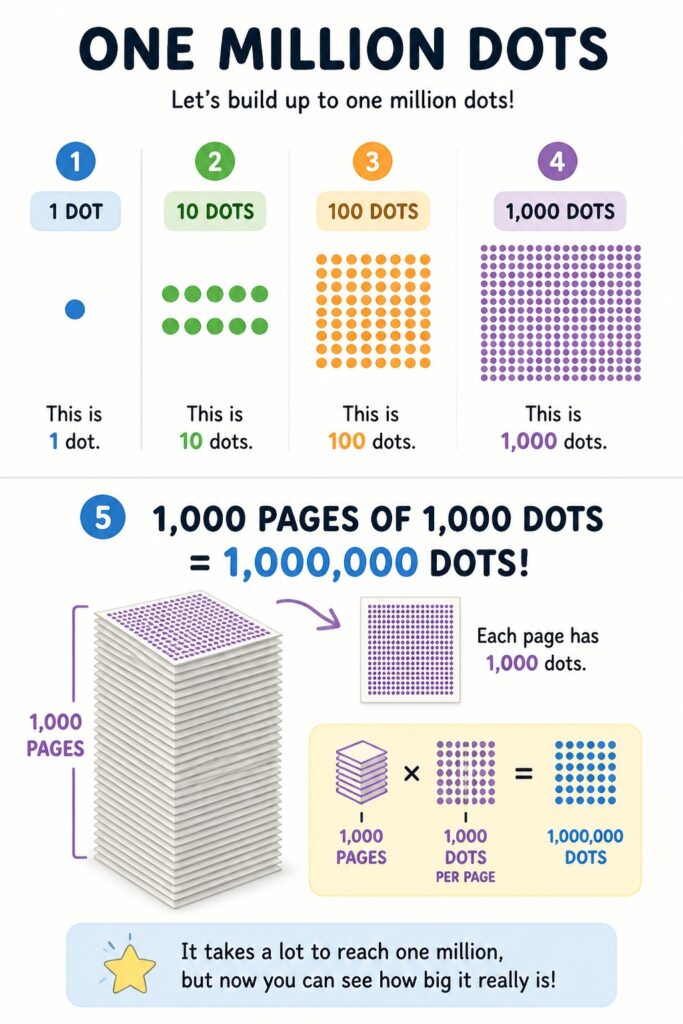
Imagine one tiny dot on a page.
Now imagine 10 dots.
Then 100 dots.
Then 1,000 dots.
At 1,000 dots, the page already starts looking busy.
Now imagine one million dots.
That would be:
1,000 pages with 1,000 dots on each page
This is why one million is better understood as groups.
One million dots is not just “many dots.”
It is one thousand full pages of one thousand dots.
Suggested image for this section
Create a simple visual showing:
- 1 dot
- 10 dots
- 100 dots
- 1,000 dots
- A final panel showing “1,000 pages of 1,000 dots = 1,000,000 dots”
Suggested image alt text:
One million dots explained as 1,000 pages with 1,000 dots on each page.
One million seconds: how long is that?
One million seconds is about 11 and a half days.
That surprises many people.
One second feels tiny. It is gone almost as soon as you notice it.
But when you collect one million seconds, they become almost two weeks.
So if you started a timer and waited for one million seconds to pass, you would be waiting for about 11 days, 13 hours, and 46 minutes.
That is a long time for something as tiny as one second.
One million minutes: now it feels bigger
One million minutes is about 1 year and 11 months.
That means one million minutes is almost two years.
This is a great example of how the thing you are counting changes the feeling of the number.
One million seconds feels like days.
One million minutes feels like years.
The number is the same.
But the size feels different because the unit is different.
One million days: now it becomes ancient
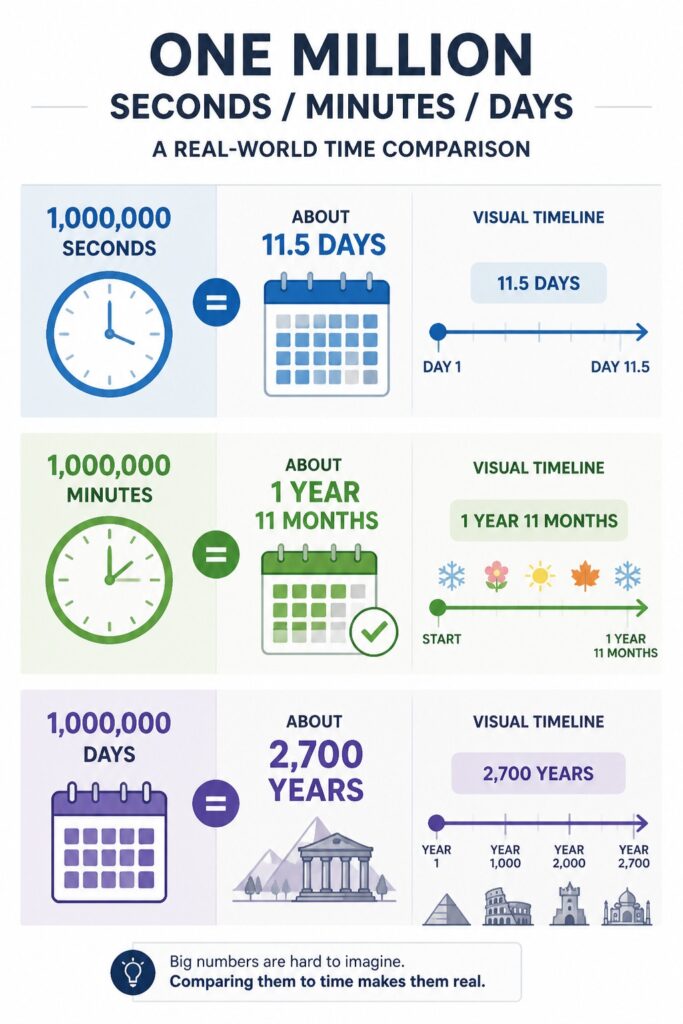
One million days is about 2,700 years.
That is older than many buildings, cities, and inventions.
So when someone says “one million,” always ask:
One million what?
One million seconds?
One million minutes?
One million people?
One million dollars?
One million stars?
One million grains of rice?
The number stays the same, but the meaning changes depending on what you are counting.
One million in money
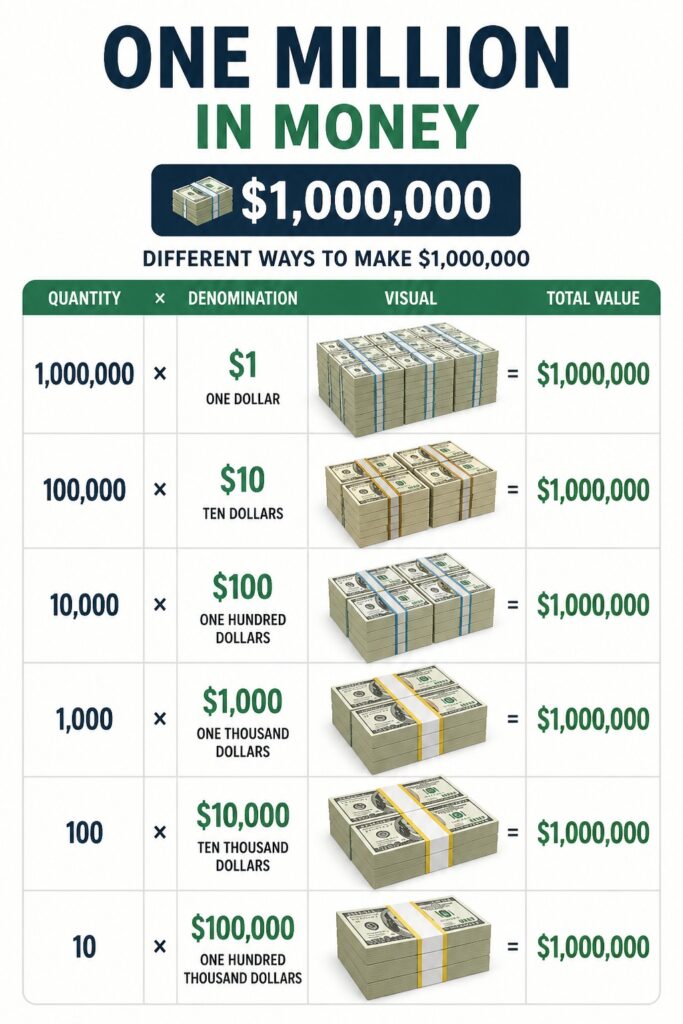
If you had one million dollars, you would have:
$1,000,000
That is a lot of money.
But even one million dollars becomes easier to understand when you break it into groups.
For example:
| Group Size | How Many Groups Make One Million? |
| $1 | 1,000,000 groups |
| $10 | 100,000 groups |
| $100 | 10,000 groups |
| $1,000 | 1,000 groups |
| $10,000 | 100 groups |
| $100,000 | 10 groups |
So one million dollars is not one magical number.
It can be understood as:
1,000 groups of $1,000
or
100 groups of $10,000
or
10 groups of $100,000
Big numbers become easier when you split them into smaller pieces.
One million people
One million people is like a very large city.
Most schools have hundreds or maybe a few thousand students.
A sports stadium might hold tens of thousands of people.
But one million people is much bigger than one stadium.
To imagine one million people, think of many full stadiums together.
If a stadium holds 50,000 people, then one million people would be like 20 full stadiums.
That is a powerful way to imagine one million.
One million grains of rice
A single grain of rice is tiny.
A handful of rice may have hundreds of grains.
A cup of rice may have thousands of grains.
But one million grains of rice would be a very large amount.
This is a useful example because it shows how tiny things can become huge when there are enough of them.
One grain of rice feels small.
One million grains of rice feels completely different.
That is what big numbers do.
They turn tiny things into something massive.
Big Number Playground challenge
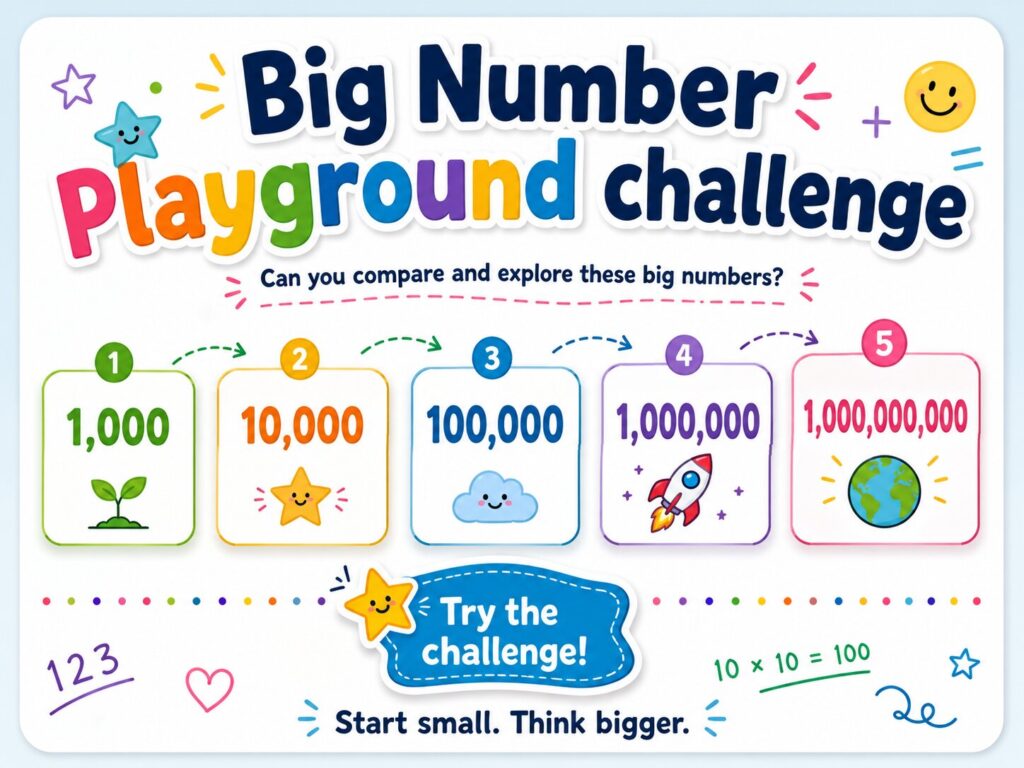
Here is a simple challenge.
Open Big Number Playground and try comparing these numbers:
- 1,000
- 10,000
- 100,000
- 1,000,000
- 1,000,000,000
Look carefully at what changes each time.
Do not only look at the words.
Look at the zeros.
Ask yourself:
- How many zeros were added?
- How many times bigger did the number become?
- When did the number start feeling too big to imagine?
- Which number felt easy?
- Which number felt huge?
This is the best way to learn big numbers.
Not by memorising.
By playing, comparing, and noticing patterns.
A simple activity for kids
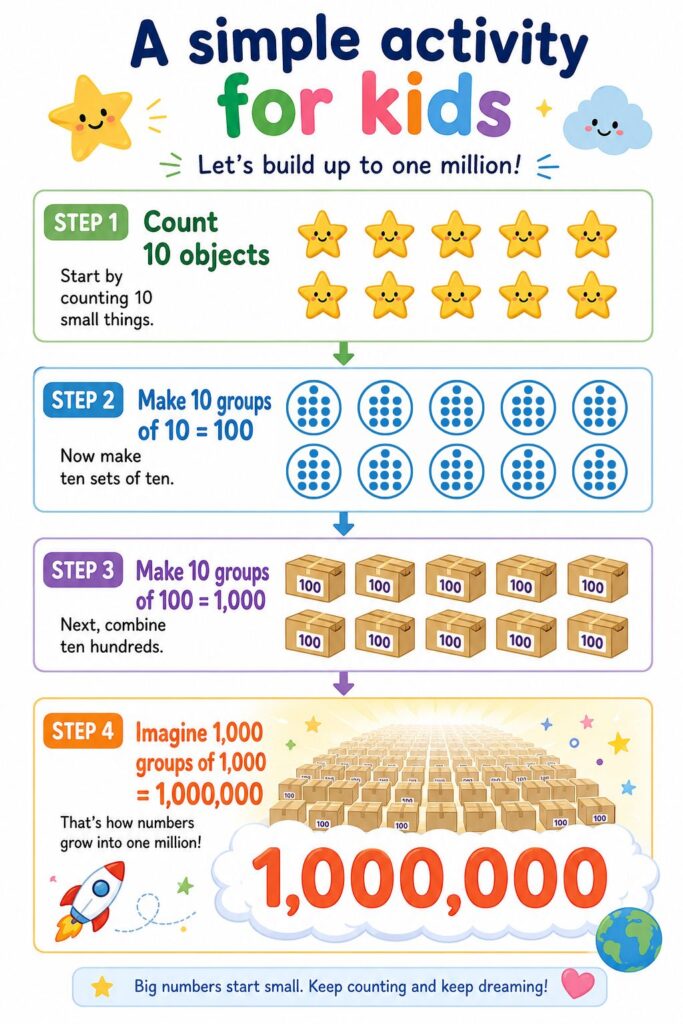
Here is a quick classroom or home activity.
You need:
- Paper
- Pencil
- Small objects like beads, buttons, rice, blocks, or dots
Step 1: Start with 10
Count 10 objects.
This feels easy.
Step 2: Make 10 groups of 10
Now you have 100.
This still feels possible to imagine.
Step 3: Imagine 10 groups of 100
Now you have 1,000.
This starts to feel bigger.
Step 4: Imagine 1,000 groups of 1,000
Now you have 1,000,000.
At this point, you probably cannot count everything one by one.
That is the lesson.
One million is the number where grouping becomes more useful than counting.
One million compared to one billion
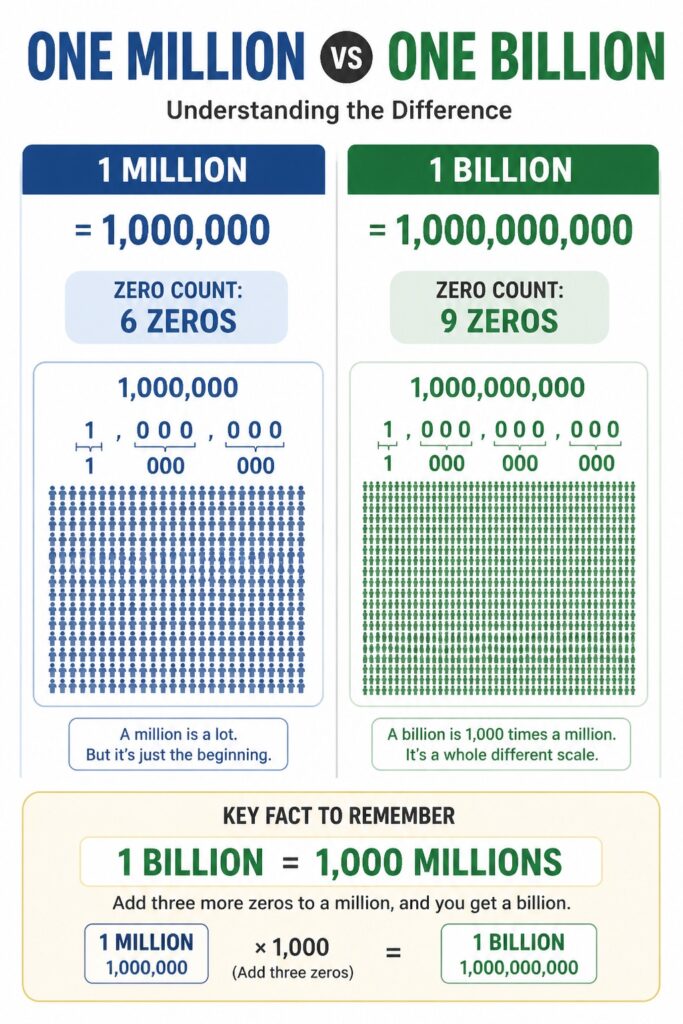
One million is big.
But one billion is much bigger.
Here is the difference:
| Number | Written Form | Number of Zeros |
| One million | 1,000,000 | 6 |
| One billion | 1,000,000,000 | 9 |
One billion has nine zeros.
That means:
One billion is 1,000 millions.
So if one million is already huge, one billion is one thousand times bigger than one million.
This is one of the most important ideas in big numbers:
Bigger number names are not just a little bigger. They can be thousands of times bigger.
Why kids should learn one million before bigger numbers
One million is a great starting point for learning big numbers because it helps kids understand three important ideas:
1. Place value
One million teaches children that the position of a digit matters.
The number 1 means something very different in:
- 10
- 100
- 1,000
- 1,000,000
The digit may look the same, but its place changes its value.
2. Grouping
One million teaches that big numbers are easier when we group them.
Instead of thinking about 1,000,000 individual things, we can think:
1,000 groups of 1,000
That is much easier.
3. Scale
One million helps children understand scale.
Scale means how big something is compared to something else.
For example:
- 1,000 is much bigger than 100
- 1,000,000 is much bigger than 1,000
- 1,000,000,000 is much bigger than 1,000,000
This skill is useful in maths, science, money, population, space, and technology.
Common mistake: thinking one million and one billion are close
A lot of people know that one million and one billion are both big numbers.
But they often do not realise how far apart they are.
One million is:
1,000,000
One billion is:
1,000,000,000
That is not just three extra zeros.
Those three zeros mean one billion is 1,000 times bigger than one million.
A simple way to remember it:
One million seconds is about 11.5 days.
One billion seconds is about 31.7 years.
That comparison makes the difference much easier to feel.
Quick one million quiz
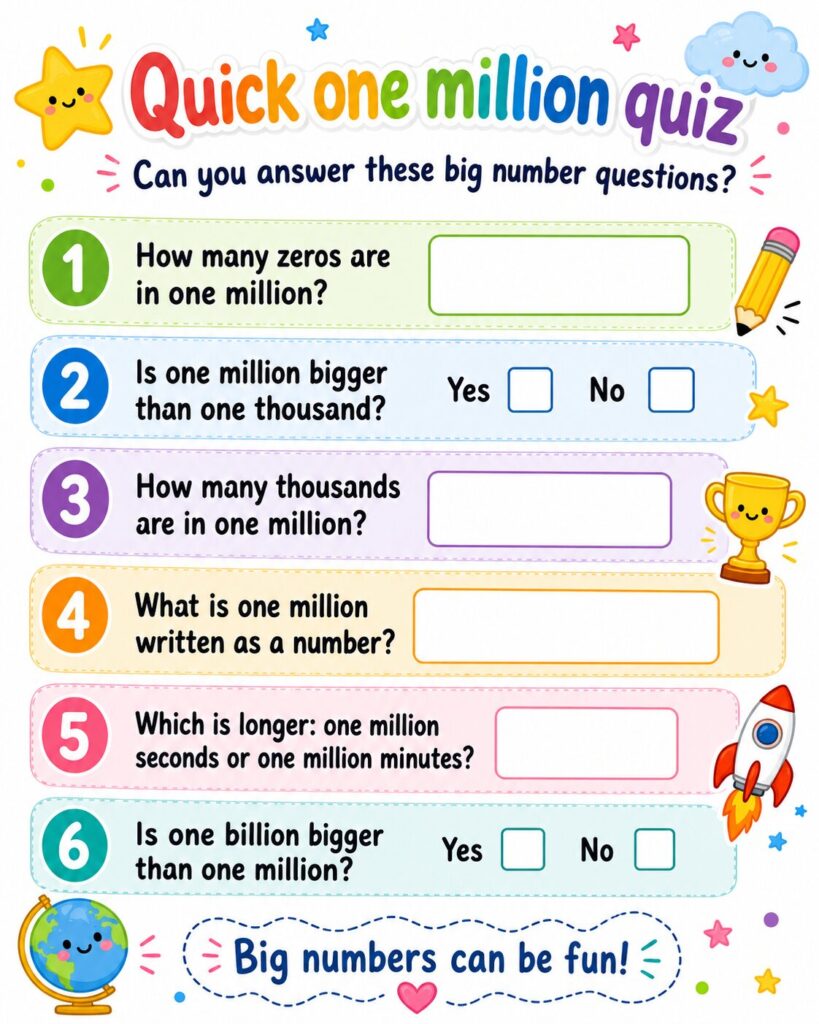
Try these questions.
1. How many zeros are in one million?
Answer: Six zeros
2. Is one million bigger than one thousand?
Answer: Yes
3. How many thousands are in one million?
Answer: 1,000 thousands
4. What is one million written as a number?
Answer: 1,000,000
5. Which is longer: one million seconds or one million minutes?
Answer: One million minutes
6. Is one billion bigger than one million?
Answer: Yes. One billion is 1,000 times bigger than one million.
Parent and teacher note
When teaching one million, do not start with memorising zeros only.
Zeros are important, but they are not the full story.
The better lesson is:
Big numbers are built from smaller groups.
When children understand that one million is 1,000 groups of 1,000, the number becomes less mysterious.
They can then use the same thinking to understand:
- Billion
- Trillion
- Place value
- Powers of ten
- Population
- Money
- Distance
- Space
- Data and technology
One million is not just a number to memorise.
It is a doorway into understanding scale.
Final answer: how big is one million?
One million is 1,000,000.
It has six zeros.
It is the same as 1,000 thousands.
The best way to understand one million is to think of it as:
1,000 groups of 1,000
One million is too large to count easily one by one, but it becomes much easier when you compare it with seconds, minutes, money, people, rice, dots, and groups.
That is the real trick with big numbers:
Do not just count them. Compare them. Group them. Play with them.
That is how one million starts to make sense.
Suggested next pages to explore
- How Big Is One Billion?
- How Big Is One Trillion?
- Million vs Billion vs Trillion
- How Many Zeros Are in a Million, Billion, Trillion?
- Place Value Chart for Large Numbers
- Big Number Quiz for Kids